INTERVIEW FOR TO BE MAGAZINE.
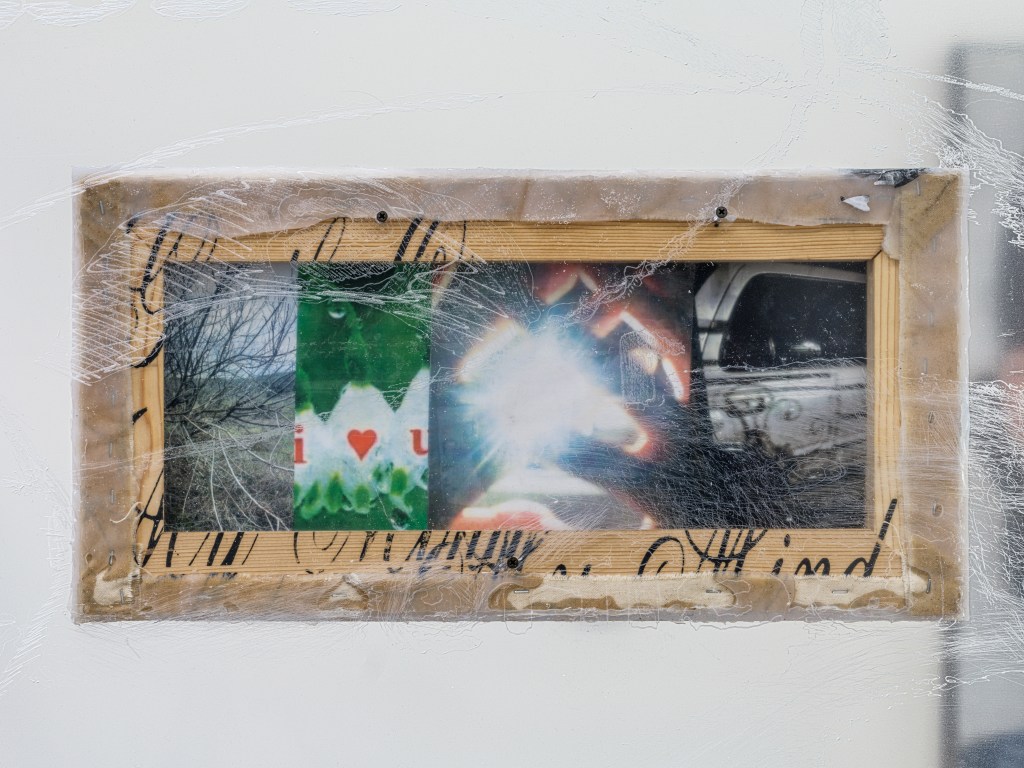
Vulnerability. Ambivalence. Longing. This is the cocktail of emotions that Zoe Alameda chose to describe her work when we spoke, and it’s the perfect introduction to the multimedia artist’s eclectic back catalogue. “If we can fuck louder than the voices inside my head, this might work,” a piece titled My Love (2024) reads. The words are superimposed over a Xerox print of a silver horse that’s mounted on wood and finished with resin splotches. Another installation takes place inside a full-size Honda CR‑V fitted out with assemblages of wood, found objects, and laser prints of fingers grazing skin and gripping bird wings. The words “Gentle on my mind” trail down one of the car’s side panels.
Then there’s the oversized plexiglass screen installed for Alameda’s latest solo show, It Takes Two Wrongs to Make It Right, hand-etched with Venn diagrams. Encased in this plexi structure are small canvases that appear to float in space, bearing prints of luminescent eggs and more fingers reaching.
Alameda’s textured layerings of materials and images hit on a very modern tension: a connected disconnection, an absent-minded presence. Everywhere you look there’s evidence of human touch and strong emotional resonance: torn fabric, sentence fragments set in resin, a cut hand, a downcast eye.
Speaking with Alameda from her Los Angeles studio, it’s clear this effect is a by-product of her process. The 25-year-old describes art making as an exercise in presence and emotional processing, a kind of hands-on therapy. Through this embodied practice, Alameda invites us into her mental archive—a “thinking map”, to use her words—where the images and objects she’s collected overlap to form new meaning.
An obsessive documenter, painter, sculptor and tattoo artist, Alameda blends formats to create her own visual language—a vision that’s set to go global this year with her first solo shows outside the United States. On the precipice of this new chapter, we phoned her up to discuss presence in an age of digital ambience and immortalising McNuggets in art.
LUCY JONES Your work captures the chaotic beauty of our current moment in a really cool way and reads almost as an externalisation of your interior reality. What’s your current emotional state?
ZOE ALAMEDA Thank you! Current emotional state… right now I am just waking up, so I’m tired. I feel like my work will very much mimic how I’m feeling. And in general, I’ve been having a lot of growing pains. I’m falling in love with somebody new, so I’m really leaning into that. I’m thinking about how things are going to be changing and all the travels that I’m planning this year. So feeling a mix of excitement and also nervousness. I see my work as a big thinking map, so it’ll sort of plot all of these things however they appear.
LJ If you had to pick three emotions to best describe your work, what would you choose?
ZA I would say, vulnerability, ambivalence—thinking a lot about the push and pull within my work—and also longing.
LJ I also feel like there’s a sense of nostalgia to it. You’re representing the present, but through the lens of a future self, kind of looking back through the vortex. Does that resonate with you?
ZA Yeah, I actually love that question a lot. Often I feel like I’m thinking ahead of myself without really realising that I do so. I’m a pretty type A person, or maybe just a pretty ambitious person in general. I like to have a lot of goals and a vision of what I imagine my future self to be feeling: the kind of person that I want to be, or how I wish I got to feel, or where I want to be.
There’s a lot of unintentional effort to try to control all of those things: emotion versus reaction, you know? There’s a big thing between being in control versus not being able to control something—being excited or anxious about something. Above all, I just have to constantly remind myself to be present. When I’m making work, I’m intentionally telling myself to slow down and attempt to be in the moment. And I think that action is exemplified in my work. Sometimes I’m successful with that, and other times I’m not.
LJ What does the successful version look like?
ZA I think about what it means to be present. And a lot of times it’s centered on the body, centered on the self. The essence of slowing down is being self-reflective. For example, in my work, if I’m referencing a very overstimulating image, or multiple images at once, that’ll very much mimic my headspace or the act of me trying to process something. Whereas transparency is really just a literal translation of me wanting to be open and reflective.
LJ It’s almost like these different states?
ZA Something like that, yeah.
LJ There’s something ‘internet’ about your art as well. Is that an aesthetic you’re intentionally trying to tap into, or just a reflection of the world that we live in?
ZA It used to be something that I was more intentionally trying to project. In some of my works I was doing a lot of screen grabs from the iPhone—the volume symbol or a keyboard. Nowadays I’m trying to be a little more subtle, or at least a little more niche with it. I still use a lot of screenshots in my work, but maybe I’ll include a screenshot from a TikTok video that I’ve seen without any of the text, or just ways that aren’t so on the nose.
That being said, it also goes in line with my work not being about the internet anymore, but more so seeing that as the foreground for a lot of the topics and the emotions of why I feel this way; it’s because I’m on my phone all the time, but it’s not about the phone.
LJ We’ve also shifted to this more ambient form of being online—where it’s just always kind of present. But as you say, we’re not reflecting on it in these really literal ways.
ZA I’m trying to really narrow in on imagery and, as an artist, Instagram will be one of your biggest platforms to look for inspiration. You’re looking at so many other artists’ work. You’re looking at different references for potential new work. And then I’m collecting my own images, taking my own photos. It takes a lot of time for me to sift through all of this new material, and the main place that I do that is on my device. Trying to isolate the noise and focus more on the abundance of imagery is more of an interest now.
LJ Going back to your earlier work, as well as how you came to art in general, has that always been tied to the internet? What were your early relationships with both?
ZA I was always interested in the internet—I’ve always been online since I was a kid—but I don’t think it necessarily was about the internet when I started making work. It was always a space for me to be emotionally reflective. When I was a teenager, I didn’t understand it as much. I mean, I still don’t understand a lot of my emotions now. But ten or fifteen years ago, I was a lot more immature [laughs]. I grew up around the emo/hardcore scene—or at least wanted to be in that space—and I was really into anime. A lot of those themes, when they cross paths, have this internetty, video game sort of stylistic energy. So aesthetically, my work looked like that, but I didn’t know I was tapping into it at the time.
LJ I wanted to talk more about your material process. You touched on the use of layering in your work or semi-transparencies—can you expand a bit more on what kind of effects you’re trying to create through that? For me, it creates a distance from some of the images, which gives them the quality of memory.
ZA Memory is always such a strange word for me, because a lot of the work I’m trying to make is vague. Or at least, I don’t understand what I’m making—not even after I’ve made it. A lot of the time, it’s still a bit of a question mark. Or it takes me multiple works to get closer to understanding my own feelings. But working in that way, while it used to be really scary, now I find more comfort in it. It gives me space to be vaguely familiar and vaguely sentimental about the things around me. Nothing is too literal.
For instance, I’ve been making a lot of work with images of dogs or eggs. The work I’ll make is not about eggs; it’s not about canines. It’s more so the emotional residue in that. It’s thinking about slow mornings. Thinking about how cute it is to hold something and feel sentimental. It’s more driven by feeling in that sense.
LJ What happens in that stage of the actual making?
ZA Well, we talked about whether my work is tied to the internet or not and agreed that it is, but it’s no longer directly about it. My goal right now is to channel those feelings, or at least the act of someone who is a pretty heavy scroller, into something very present. Whenever I talk to my therapist, it’s like, “Okay, well, what are the things that I need to do to be present? Put your phone down, take a walk, move your body, make sure you’re eating right.” And whatever those attempts are for me to try and slow down in my personal life.
When it comes to my life as an artist, while I’m referencing a lot of digital images, I want to work completely analogue. I want to work completely tactilely. I want to be able to feel my emotions out. I want to feel, you know, things.
LJ There’s a lot of found objects in your work—and I do feel that there’s that quality of sentimentality in the pieces themselves. What draws you to particular objects or images?
ZA It’s always hard to describe. Lately, people see car parts and they think of me, which is really funny. I’m trying to see what else I can do outside of that realm. I’m thinking a lot about assigning meaning to things that may not necessarily carry it on their own. For example, with the car, it feels like a distant object. It feels like this thing that’s just very everyday, at least in LA.
LJ What’s the most random object that you’ve put in an artwork?
ZA McNuggets [laughs]. I cast a series of different McDonald’s food items in cement just to see if they would preserve, and they did. They became rock solid and they’re just there forever.
LJ With that way of working, do you feel like you’re always ‘on’? It must influence the way you see the world on a day-to-day scale if you’re always looking out for this emotional resonance of objects.
ZA Definitely. And that’s what I like about it too, because it helps me feel like I’m working towards that practice of trying to be present. Instead of looking at my phone while I’m taking a walk, it’s like, “Okay, well, I can look at the cracks of the floor and see if there’s a piece of trash that I want to pick up.” I admire street photographers and assemblage artists. I want to collect all of the different ways of looking and different ways of making and put them into one thing.
LJ Has there been any work you’ve shown recently where people responded in an interesting way?
ZA The most recent show I did was my solo show. That closed at the end of January. I always love hearing people’s questions about why I pick certain images. And when they hear that I don’t know most of the time, it’s also funny. It prompts them to come up with their own memory attached to the image. And more often than not, I find that my experience is not that far from theirs. In the same way that you’re posting something on Instagram and wanting to relate to people, but doing it in your own way—that’s kind of what art making feels like to me sometimes.
LJ I have this sense that your works are in process; in a way, they’re never really done. Do you see art as a way to access that open-ended state?
ZA Definitely. If I had all the answers, my work would look a lot different. And because I have so many questions, even though I’m looking for answers and don’t have them, it makes it more fun and more frustrating. I constantly refer to that frustration like it’s a bad thing, but it presents itself as being very important to how the work becomes itself.
LJ What are you making at the moment?
ZA I am working on me [laughs]. I’m taking a break from direct making. I have a lot of exciting projects coming this year, some more international shows that I’m nervous about. I’m deep cleaning my studio. I’m deep cleaning my bedroom. Travelling a lot, just to refine those experiences and kind of settle into my head.
And then I’m thinking about doing some bigger installations, expanding on the idea of double-sided paintings, but really using space to understand that. So, while it’s been fun to see the work itself, I want to create structures that the work can sit atop or be presented with.
LJ Do you tend to collect reference material when you travel?
ZA I take a lot of photos. In my recent solo show, a lot of those photos were from Paris and from my daily walks. I hope to have a lot more imagery to work with this year. I really want to get photos of people holding hands and more birds.
LJ That’s so nice in the current moment of where the world is at.
ZA I’m 25 and I guess the most pressing thing for me—knowing that our world is so fucked up, and I’m an American travelling outside of the country, trying to have fun and whatever—is attached to that fear of stability for my future. And just being happy, whatever happiness means. Does that mean ‘successful’? Or is happiness its own thing? I feel like I’ve always been a romantic sort of person too. So it’s just trying to lean more towards those ideas, just for now.
LJ Is there anything when you’re making work that you hope people will connect to?
ZA I never make work with the intention of someone feeling a certain way because it’s more of a place for me to express myself. But, I want people to feel a bit softer. I want people to feel slow—that sort of pace that I’m attempting to be in—or a little crazy, also.
When I make something that’s so crazy and ironic, I want people to see through that and not dismiss it and know that there’s a layer of sentimentality underneath the crazy.


Leave a Reply